The Architecture of Palingenesia: Freemasonry, the Egyptian Mysteries, and the Transmission of Esoteric Science
(The website has been rapidly populated with text derived from notes while work is focused on the research effort. Future Updates will seek to clarify and improve the specific language presented on the website, It is being made available now in its current form due to the urgency implied by its inherent findings)
The historical emergence of Speculative Freemasonry in the early modern period represents the surfacing of a profound and continuous initiatic science that originated millennia earlier in the Nile Valley. Far from being a mere fraternal guild or an invention of the eighteenth-century Enlightenment, the Masonic institution operates as the terminal custodian of an advanced psychological and cosmological architecture. This architecture was first codified by the ancient Egyptian priesthood, systematically preserved by a sequence of intermediary mystery traditions, and ultimately embedded into the structural layout and ritual lexicon of the modern Masonic lodge. The supreme objective of this esoteric lineage is the PALINGENESIA—the radical, conscious rebirth of the human spirit. By examining the historical transmission chain of these mystery schools, their instrumental role in the foundation of the American Republic, and the precise symbolic ciphers preserved within the lodge—most notably the twin pillars of Jachin and Boaz and the botanical translation of the Egyptian lotus—a cohesive historical narrative is revealed. Freemasonry is the surviving exoteric vessel for an ancient esoteric technology designed to liberate human consciousness from automated ARCHONIC DRIVES.
The Egyptian Priestly Teachings and the Science of the Soul
To comprehend the essence of the esoteric knowledge transmitted to Freemasonry, it is necessary to first interrogate the psychological framework of the ancient Egyptian mystery schools. The Egyptian priesthood did not view the human soul as a monolithic entity; rather, they developed a highly sophisticated taxonomy that divided human consciousness into distinct functional components. The most critical of these components within the initiatic context were the Ka and the Ba. The Ka represented the vital life-force, the animating divine spark, and the foundational foundation of physical manifestation, while the Ba represented the individual personality, the mobile consciousness that navigates the realm of experience.
The primary objective of the Egyptian esoteric tradition was the deliberate and highly perilous union of the Ka and the Ba during the life of the initiate, a fusion that produced a transcendent, immortal state of consciousness known as the Akh (the luminous or effective spirit). This transformation was mapped cosmologically as the twelve-hour nocturnal journey of the sun god Ra through the Duat (the underworld), meticulously detailed in monumental funerary texts such as the Amduat and the Book of Gates. During this descent, the consciousness of the initiate was required to navigate past specific guardians, surrender its attachments to the material drives, and undergo a profound psychological dissolution at the "nadir"—the sixth hour of the night. It is only after surviving this ego-death that the consciousness could emerge resurrected at the twelfth hour, perfectly unified as the Akh.
In the Hellenistic era, as the esoteric science of the Egyptian temples was translated into the philosophical vocabulary of the Greek world, this process of producing the Akh was designated by the technical term PALINGENESIA (from palin, meaning "again," and genesis, meaning "birth"). The concept of palingenesia constitutes the absolute core of the mystery school teachings. Its most explicit philosophical documentation is found in Corpus Hermeticum XIII, a foundational text of the Alexandrian Hermetic tradition, which synthesized Egyptian temple rites with Neoplatonic thought.
Within the discourse of Corpus Hermeticum XIII, the initiate Tat is guided by Hermes Trismegistus through the precise mechanics of this spiritual rebirth. Hermes explains that the uninitiated human soul is automatically governed by twelve irrational tormentors—a sequence of psychological constraints that correspond to the twelve signs of the zodiac, encompassing destructive drives such as ignorance, grief, intemperance, desire, injustice, and deceit. The PALINGENESIA is achieved only when these twelve archonic tormentors are systematically expelled from the psyche and replaced by ten divine powers, including self-knowledge, joy, continence, perseverance, and truth.
This rebirth is not presented as an allegory for gradual moral improvement or exoteric religious piety; it is described as a radical, threshold-crossing alteration of consciousness that restructures the individual's perceptual apparatus. The palingenetic process frees the individual from the automated, conditioned responses of the lower planetary drives, resulting in a consciousness that the tradition describes as "masterless." The reborn initiate is no longer subject to the arbitrary governance of the archonic forces but exists in a state of direct, unmediated resonance with the divine. This psychological emancipation is the exact esoteric payload that the Egyptian mysteries sought to transmit, and it remains the central, if frequently veiled, objective of Masonic initiation.
The Intermediary Transmission Chain: From the Nile to the Lodge
To protect this esoteric core, the ancient mystery traditions universally adopted a strict TWO-TIER EDUCATIONAL AND RITUAL STRUCTURE, dividing their teachings into the "Lesser Mysteries" and the "Greater Mysteries." The Lesser Mysteries consisted of exoteric (outer) rituals, moral allegories, and foundational purifications accessible to the general initiate or the public. These outer rites served as a preliminary screening and preparatory stage. Conversely, the Greater Mysteries contained the esoteric (inner) teachings, reserving the true psychological mechanics of the PALINGENESIA and sacramental rites strictly for the fully prepared Adepts. This bifurcated architecture—seen in the Eleusinian separation of spring and autumn rites, the Pythagorean division of acousmatici and mathematici, and the Egyptian temple layouts—ensured the core science survived intact while simultaneously providing a meaningful moral framework for the broader society.
The survival of the PALINGENESIA required a continuous and resilient chain of transmission. As shifting political powers and orthodox religious institutions sought to suppress direct, unmediated initiatic experiences in favor of dogmatic compliance and ecclesiastical monopolies, the Egyptian science of the soul was forced underground. The knowledge was subsequently passed through a succession of intermediary groups that acted as protective vessels, translating the core technology into the evolving symbolic vocabularies of their respective eras.
| Era / Location | Custodial Institution | Mechanism of Esoteric Transmission |
|---|---|---|
| c. 3100 – 392 BCE | Egyptian Priestly Schools | Acted as the primary repository of the Ka-Ba-Akh science. Utilized monumental temple architecture and complex texts (Amduat, Book of Gates) to physically and textually encode the twelve-stage journey of the soul. |
| c. 1500 – 392 BCE | Eleusinian & Pythagorean Schools | Translated the Egyptian cosmological model into the Greek world. Maintained a strict two-tier educational structure (acousmatici vs. mathematici). Culminated in the Greater Mysteries and the sacramental vision of rebirth. |
| 1st – 3rd Century CE | Alexandrian Hermeticism | Synthesized Egyptian temple rites with emerging Neoplatonism. Produced the Corpus Hermeticum, codifying the mechanics of the palingenesia into written philosophical dialogue designed for the initiate. |
| 9th – 14th Century CE | Islamic Sufi Orders | Figures like Dhu'l-Nun al-Misri (born in Akhmim, a surviving Egyptian temple node) transferred Hermetic gnosis (ma'rifa) into Sufi mysticism. Orders like the Bektashi integrated Neoplatonic, Kabbalistic, and Hermetic symbolism. |
| 12th – 17th Century CE | Templars & Rosicrucians | European chivalric and esoteric orders encountered Middle Eastern mysticism during the Crusades and via Al-Andalus. Encoded the palingenetic process into complex alchemical, geometric, and chivalric allegories. |
| 17th Century – Present | Speculative Freemasonry | Formalized the accumulated esoteric symbols into a strict system of degrees. Encoded the twelve-stage journey within the architecture of the Lodge and the central psychodrama of the Master Builder. |
The transition from late antiquity into the Islamic Golden Age provides a vital and often obscured link in this chain of transmission. Following the forced closure of the pagan temples by Roman edicts in the late fourth century—an event that formally suppressed the Eleusinian Mysteries and scattered the priesthood—the practical science of the Egyptian tradition survived in isolated geographical nodes. One of the most significant of these nodes was the city of Akhmim (ancient Panopolis) in Upper Egypt. Akhmim was the birthplace of Zosimos, the foundational figure of Greco-Egyptian alchemy, and centuries later, it produced the eminent mystic Dhu'l-Nun al-Misri (791–860 CE).
Dhu'l-Nun is historically documented as a central transmission node bridging the surviving Egyptian Hermetic temple tradition and the emerging tradition of Islamic Sufism. He learned from temple priests who still comprehended hieroglyphic texts and subsequently introduced the concept of ma'rifa (direct, experiential gnosis) into Sufi doctrine. By doing so, Dhu'l-Nun effectively preserved the Hermetic PALINGENESIA within an Islamic mystical framework. This knowledge propagated through various Sufi tariqas, heavily influencing syncretic orders such as the Bektashi.
The Bektashi Order, a heterodox Sufi dervish brotherhood, functioned as a critical repository. Academic documentation reveals that Bektashi doctrines represent a profound convergence of shamanism, Sufi mysticism, Buddhism, Manichaeism, Christianity, Neoplatonism, Kabbalah, and reincarnation. Because of its highly syncretic nature and its structured initiatic degrees, early twentieth-century scholars such as H.N. Brailsford observed that the Bektashi Order's place in Islam was "most nearly analogous to that of Freemasonry in Christianity." Like the mystery schools before it, the Bektashi maintained the two-tier structure, utilizing public-facing exoteric ceremonies while reserving their profound esoteric unity concepts for inner initiates.
This explicit connection directly birthed a famous appendant body of American Freemasonry: the SHRINERS (Ancient Arabic Order of the Nobles of the Mystic Shrine). The simplified founding myth of the Shriners often credits an "Arab diplomat's party," but the historical founding contact was directly with the Bektashi Order. William J. Florence, one of the Shriners' co-founders, attended Bektashi exoteric ceremonies in Marseilles, Algiers, and Cairo as a visiting Mason. Inspired by the vibrant outer temple rituals and the underlying claim of an esoteric unity connecting Islam, Judaism, and Christianity to the mysteries of ancient Egypt, Florence brought this framework back to the United States. Thus, the Shriners were formed as a fraternity that wrapped its exoteric sociability in the colorful outer garments of the Bektashi tradition, demonstrating how the outer rites of the Lesser Mysteries act as a vehicle to perpetuate the ancient transmission chain.
From the Middle East, this knowledge filtered back into Europe through the conduits of the Crusades, the translation movements in Moorish Spain, and the survival of Kabbalistic communities. The Knights Templar, and later the Rosicrucian networks of the early seventeenth century, acted as the immediate predecessors to Speculative Freemasonry. When Freemasonry formally emerged in the historical record, it possessed a ritual structure heavily indebted to these prior transmissions, utilizing the metaphors of stonemasonry to disguise an alchemical and psychological curriculum.
The connection between Freemasonry and the Egyptian mysteries is not merely an assertion of modern comparative mythology; it is an explicit claim made by the institution's own architects. Albert Pike, the preeminent philosopher and organizer of the Ancient and Accepted Scottish Rite in America, stated unequivocally in his magnum opus, Morals and Dogma, that Masonry is a direct descendant of the ancient mysteries.
Pike observed that Masonry is "identical with the ancient Mysteries," though he noted that the modern institution often presents "but an imperfect image of their brilliancy, the ruins only of their grandeur."
He acknowledged that the true esoteric meaning—the technology of the PALINGENESIA—is deliberately veiled by false interpretations in the lower degrees, reserving the pure Hermetic and Kabbalistic explication solely for the Adepts who have demonstrated the capacity to perceive it.
The American Foundation: Freemasonry in the Colonies
The transmission of this ancient knowledge did not halt in the lodges of Europe; it was actively exported to the American colonies, where it played a foundational role in the philosophical shaping of the United States. The formalized transplantation of Speculative Freemasonry to the New World occurred in the early eighteenth century, driven by the expansionist policies of the Premier Grand Lodge of England.
The initial formal authorization for American Freemasonry was granted to Daniel Coxe (1673–1739). On June 5, 1730, Coxe was appointed by the Duke of Norfolk, Grand Master of the Premier Grand Lodge of England, as the Provincial Grand Master of the provinces of New York, New Jersey, and Pennsylvania. Coxe was a prominent colonial figure, serving as a Colonel of the Militia in West Jersey and as an Associate Justice of the New Jersey Supreme Court. While Coxe holds the historical distinction of being the first appointed Provincial Grand Master in America, the record regarding the actual constitution of active lodges under his direct, sustained authority remains sparse.
The functional establishment and proliferation of American Freemasonry is more directly traced to the efforts of Henry Price (c. 1697–1780). Born in London, Price was an industrious tailor who emigrated to Boston around 1723. Having been initiated into the fraternity in England prior to his departure, Price utilized a return business trip to London to petition the Grand Lodge for the authority to establish a formal Masonic presence in New England. In April 1733, Anthony Browne, the 6th Viscount Montagu and Grand Master of the Grand Lodge of England, issued a deputation appointing Henry Price as the "Provincial Grand Master of New England and Dominions and Territories thereunto belonging."
Armed with this authority, Price convened a historic meeting on July 30, 1733, at the Bunch of Grapes Tavern on King Street in Boston. At this assembly, Price officially presented his warrant, appointed Andrew Belcher as his Deputy, Thomas Kennelly as Senior Grand Warden, and John Quann as Junior Grand Warden, thereby constituting the Provincial Grand Lodge of Massachusetts. On that same day, upon the petition of eighteen Boston Masons, Price chartered St. John's Lodge, establishing it as the first duly constituted and continuously operating Masonic lodge in the Americas.
The institution seeded by Price quickly became the philosophical crucible for the American Revolution. The Masonic lodges of the colonies functioned as secure, egalitarian spaces where the rigidly enforced class structures and religious orthodoxies of the British Empire were temporarily suspended in favor of brotherhood, reason, and merit. This environment was highly conducive to the incubation of Enlightenment ideals and revolutionary sentiment. The Green Dragon Tavern in Boston, which the St. John's Lodge purchased in 1764 to serve as its meeting place, subsequently became the clandestine headquarters of the American Revolution. It was within these walls, steeped in the esoteric symbolism of the ancient mysteries, that figures like Paul Revere, Joseph Warren, John Hancock, and Samuel Adams collaborated with the Sons of Liberty and the Committee of Correspondence. The participants of the Boston Tea Party launched their operation from the Green Dragon, and it was the starting point for Paul Revere's legendary midnight ride.
The impact of this mystery school transmission on the formation of the United States cannot be overstated. The founding documents of the republic are deeply saturated with Masonic ideology, which is itself the political application of Hermetic and NATURAL LAW principles. The concept that inherent rights belong to the individual by virtue of natural law, rather than by the grant of a monarch or an institutional priest class, is the direct socio-political translation of the PALINGENESIA—the realization that the divine spark (Ka) resides unmediated within the individual. It is a matter of historical record that a vast proportion of the nation's architects were initiates: fifteen of the fifty-six signers of the Declaration of Independence, and twenty-eight of the forty signers of the US Constitution, held Masonic affiliations. The American republic was, in a profound structural sense, an attempt to build a macro-societal lodge based on the blueprints of the ancient mysteries.
The Vault of Enoch — A Timing Proof, and the Hebrew Grammar of Descent and Building
Where the intermediary transmission chain traced above rests on symbolic correspondence — shared architecture, shared cosmology, shared ritual grammar — the Masonic memory of Enoch offers something rarer: a correspondence that can be dated. The thirteenth degree of the Ancient and Accepted Scottish Rite, part of the historic Degrees of Perfection and known as the Royal Arch of Enoch, was already fixed in written ritual by 1760, in a French manuscript titled Précis des huit premier Grades. Its content: a light leading to an underground chamber upheld by nine arches, reached by nine steps, sealed by a stone and an iron ring; a torch extinguished by the sun's brilliance; and, on a triangular plate of gold, the sacred Name. This is not the degree's name arriving early — it is this specific content, dated and described in detail, thirteen years before the Book of Enoch itself was carried out of Ethiopia by James Bruce in 1773, and sixty-one years before Richard Laurence produced the first English translation in 1821, working alone in the Bodleian Library from a manuscript in Ge'ez — a language known in the whole of Western Europe to only a small handful of specialist Orientalist scholars, none connected to Masonic ritual-writing circles.
| Date | Event |
|---|---|
| 9th century CE | Book of Enoch last quoted in the West; disappears from European knowledge for roughly 900 years |
| 1760 | The Royal Arch of Enoch's specific content — nine arches, the golden plate, the sacred Name — already fixed in French Masonic ritual |
| 1773 | James Bruce returns from Ethiopia with three Ge'ez manuscripts — the first copies to reach European soil |
| 1773–1821 | Manuscripts held in the Bodleian, the Royal Library of France, and Bruce's own collection — readable only by the rare scholar trained in Ge'ez |
| 1821 | Richard Laurence publishes the first English translation. This is the first moment the Book of Enoch's content becomes generally accessible — sixty-one years after the ritual, and a full 1,200 years after the text vanished from Western memory |
Where the Ritual and the Text Actually Agree
Two named Masonic historians — Arturo de Hoyos, Grand Archivist of the Scottish Rite's Southern Jurisdiction, and Bernard E. Jones, author of Freemasons' Book of the Royal Arch — have traced this legend to its pre-Masonic antecedents rather than treating it as an eighteenth-century invention. A closer reading of the actual text of 1 Enoch shows precisely where the correspondence is genuine and where the Masonic ritual elaborates beyond it.
The Book of Enoch (81:1–2) has Enoch commanded to read from "the heavenly tablets," then to write down everything he has seen and entrust it to his son: "Keep, my son Methuselah, the books from the hand of your father, that you may pass them on to the generations of eternity." This charge repeats across chapters 82, 83, 85, and again in 106–108 — Methuselah named each time as the one entrusted with preserving antediluvian knowledge for a future age. The Masonic legend independently names the same figure: Enoch, warned of the coming Flood, is assisted by his son Methuselah in constructing the vault. That specific detail — Methuselah as co-preserver — is not in Josephus, who records only a general "posterity of Seth." It is distinctively Enochic.
What the ritual does not draw from 1 Enoch is its central staging — the vault, the nine arches, the discovery beneath Solomon's Temple. That mechanism traces to older, separate material: Josephus's account of the pillars of Seth (Antiquities I.ii), and a still older Judaeo-Christian legend, recorded by the Arian historian Philostorgius in the fourth century and elaborated in far greater detail by the Byzantine historian Nicephorus Callistus in the fourteenth. Callistus's account — translated into English in 1659 by Samuel Lee, in a book titled Orbis Miraculum, 114 years before Bruce's return — describes workmen rebuilding the Temple during Julian the Apostate's reign uncovering a hidden cave. The Overseers, wanting to know what lay inside, lowered a workman by rope; he found water at his ankles, felt his way to a square chamber, and touching a column rising above the water, found a book resting on it. De Hoyos himself notes plainly that this earlier version "makes no mention of Enoch's vision, the gold plate, the pillars or Solomon" — the eighteenth-century ritual fused this mechanical template (overseers, a man lowered by rope, a find near a pillar) with the separate Enochic material on preservation and transmission, and relocated it to Solomon's original Temple.
The honest picture, then, is not simple derivation. It is convergence: a distinctly Enochic transmission structure — forewarning, preservation, entrustment to Methuselah, survival for a later age — married to an older vault-discovery mechanism that had circulated in Christian historiography since the fourth century, centuries before either strand touched the Book of Enoch's actual, then-inaccessible text.
Not every Masonic historian treats this as settled. A 2013 essay in the Scottish Rite Journal directly engages this "undiscovered anomaly" framing and pushes back: the legend, its author argues, "is a composite account, which can easily be constructed from preexisting works," requiring no esoteric line of transmission at all — only the ordinary circulation of Josephus, the Callistus-Lee vault legend, and Genesis's own account of Enoch, independently available to any eighteenth-century ritual-writer with a library. That disagreement is recorded here deliberately: the timing proof stands on its own regardless of which reading of how the pieces were assembled one finds more persuasive.
The Hebrew Grammar Beneath the Names
The genealogy that produces Enoch (Genesis 5) is built, quite literally, from the Hebrew word for building. בֵּן (ben), "son," shares its root with בָּנָה (banah), "to build," and with בַּיִת (bayit) — "house," but also "household," "dynasty," and, in its fullest form (Beit ha-Mikdash), "temple." In Biblical Hebrew, to beget a son and to build a house are the same verb wearing two faces. A genealogical chain of "sons" — X ben Y ben Z — is not merely a record of descent; it is, grammatically, a chain of building. Genesis 5 hands the Masonic institution's central metaphor — a house built across generations — before the institution itself existed.
Several names within that chain carry meanings precise enough to matter, and two are glossed by the text itself — the strongest kind of etymology available. Seth, Adam's third son, is named for being "appointed" (Genesis 4:25 — Eve's own words, in place of the murdered Abel). Noah is named for "rest" (Genesis 5:29 — Lamech's own stated hope, in a passage that plays on the sound of the name directly). Mahalalel, Jared's father, means "Praise of God," a clean and uncontested compound.
Jared, Enoch's father, is יֶרֶד (Yered), from ירד (yarad), "to descend." The Book of Jubilees makes this explicit rather than incidental: it was in Jared's days, Jubilees says, that "the angels of the Lord descended to earth" — the generation is named for the Watchers' descent recorded in 1 Enoch's own opening chapters. Enoch himself is חֲנוֹך (Chanokh), from חָנַך (chanakh), "to dedicate, to initiate, to train" — the same root that gives Hebrew its word for Chanukah, the Feast of Dedication. Born into a generation marked by descent, Enoch is named, in the literal grammar of his own language, the initiated one — and his fate reverses his father's direction entirely: not death, not descent, but a crossing the other way. Genesis 5:24 says he "walked with God, and he was not, for God took him" — the one figure in the whole antediluvian chain who does not die, but crosses the threshold from mortal to divine without passing through the grave at all.
The most consequential name in the line belongs to Enoch's son. מְתוּשֶׁלַח (Metushelach, Methuselah) is widely read as a compound of muth ("death") and shelach ("to send forth") — "his death shall bring [it]." The reading is genuinely contested; an equally circulated alternative gives the more mundane "man of the javelin," and no scholarly consensus resolves it. What is not contested is the arithmetic. Genesis 5:27 gives Methuselah's total lifespan as 969 years. Add his age at Lamech's birth (187), Lamech's age at Noah's birth (182), and Noah's age when the Flood began (600), and the sum is 969 — identical. However the name is read, Methuselah dies in the exact year the Flood arrives, calculable directly from the numbers Genesis itself supplies.
Two names in the same line resist confident reading, and are worth naming plainly rather than forced into a pattern the text does not itself supply. Kenan's root is disputed, and Lamech's meaning — Methuselah's son, Noah's father, not to be confused with the earlier, unrelated Lamech of Cain's line — has no scholarly consensus.
A Structural Echo of the Book of Gates
The correspondence extends past narrative into architecture. The Astronomical Book of Enoch (chapters 72–82) — the same section that contains the Methuselah-transmission material discussed above — organizes the entire cosmos around twelve gates: the sun's twelve gates of rising and setting, the moon's parallel set, and a further twelve gates governing the winds (ch. 76). Enoch is guided through this gated cosmography by the angel Uriel and reports what he witnesses for the benefit of later generations — structurally, an initiate's guided passage through a sequence of numbered thresholds, each governing a portion of the celestial order. This is the same organizing principle already established earlier on this page for the Egyptian Book of Gates: twelve hours, twelve gates, a guided passage through the Duat under angelic or divine escort, undertaken so the knowledge of the passage can be preserved and transmitted. Two independent traditions — Second Temple Jewish and New Kingdom Egyptian — reach for the identical structural device: a twelve-gated cosmos, traversed under guidance, in service of preserving what would otherwise be lost.
Death Before the Deep
Methuselah's death is not a standalone curiosity. Genesis 7:11, describing the Flood's onset, uses the identical Hebrew word Genesis 1:2 uses for the primordial waters that existed before creation: tehom — "the fountains of the great deep [tehom] were broken up." The Flood, in the text's own vocabulary, is not simply a disaster. It is a partial return of the cosmos to its pre-creation state — the same category of chaotic deep this page has already traced through Nun and the nightly waters of the Duat. Noah's emergence afterward, blessed in language that deliberately echoes Genesis 1's own words to the first humans, completes the pattern: submersion in the primordial deep, followed by a world made new.
The German biblical scholar Hermann Gunkel first argued, in his 1895 study Schöpfung und Chaos in Urzeit und Endzeit ("Creation and Chaos in Primeval Time and End Time"), that tehom carries the mythological background of Tiamat, the Babylonian goddess of the primordial sea. Later linguists have disputed the precise derivation, but the broader point Gunkel established — that tehom names the same category of primordial chaotic deep recognized across the ancient Near East — remains the working position of mainstream biblical scholarship today.
Methuselah's death is the threshold before this passage begins. Whichever reading of his name one accepts, his death and the world's submersion into tehom arrive in the same year: death, then the primordial waters, then a world made new — the same structure this page has already traced through the Duat, arriving independently through an entirely different vocabulary.
Older Than Noah
The flood-and-survivor narrative Genesis tells through Noah is not unique to Genesis. Three older Mesopotamian accounts tell structurally the same story under different names — not Noah's name, but Noah's shape, which is the stronger evidence: Ziusudra, hero of the Sumerian Eridu Genesis (composition dated to roughly 2300 BCE), Atrahasis, hero of the Akkadian epic bearing his name (approximately eighteenth century BCE), and Utnapishtim, whose account survives on Tablet XI of the Epic of Gilgamesh (fragments from the second millennium BCE, the standard version by the seventh century BCE). All three predate the written form of Genesis by centuries to over a millennium.
The correspondence runs past theme into specific, checkable detail. Each hero is warned by a god of an imminent flood and given precise instructions for building a vessel. Each boards his family and representatives of every animal species. Each releases birds in sequence to test for dry land — Utnapishtim sends a dove, then a swallow, then a raven that does not return; Noah sends a raven, then a dove three times, the last of which does not return (Genesis 8:6–12). Each vessel comes to rest on a mountain — Nisir for Utnapishtim, Ararat for Noah, both within the same range. Each hero offers sacrifice on landing, and in both traditions the deity is specifically described as pleased by the scent of the offering.
One correspondence is linguistic rather than narrative, following the same pattern this page has already established for the lotus. Noah is instructed to caulk the ark with pitch — Hebrew kofer — a direct cognate of the Akkadian kupru, the identical term Utnapishtim uses for the same substance (Genesis 6:14). A borrowed word, preserved intact across the translation of an entire narrative.
The physical dimensions converge as well. The deck areas of the three arks — Atrahasis's, Utnapishtim's, and Noah's — come to approximately 14,400, 14,400, and 15,000 square cubits respectively.
This is the same threshold logic already established at the entrance to the Lodge itself. Jachin and Boaz mark the Gemini gateway — the tension of solar and lunar opposites the initiate must pass between, neither residing permanently in one nor the other. Enoch's own passage performs the identical function one register higher: not a gate between two pillars, but the threshold between mortality and the imperishable — walked, not died into, at the exact moment his own name identifies him as ready. Methuselah's death, the Flood's submersion into tehom, and Noah's emergence into a re-created world repeat the same structure one generation later, in the same family, using the identical vocabulary this page has already traced through Nun and the Duat — and an entirely independent vocabulary, three separate times over, in Sumerian, Babylonian, and the older vault-legend this section opened with. The vault Enoch's legend describes, and the timing that places its telling before its supposed source, stand as this page's clearest instance of the pattern argued throughout: correspondence that predates its own explanation, recurring in traditions that never touched one another.
The Threshold of the Mysteries: Jachin, Boaz, and the Nature of the Temple
To comprehend how Freemasonry precisely encodes the Egyptian esoteric science, one must analyze the primary architectural threshold of the Lodge: the twin pillars of Jachin and Boaz. Modeled upon the biblical descriptions of King Solomon's Temple, these pillars stand at the entrance of the Masonic lodge, functioning as the ultimate symbol of duality, cosmic equilibrium, and the gateway of initiation.
The orientation and cosmological significance of these pillars are highly specific and derive directly from astronomical observation. According to the textual and archaeological consensus regarding Solomon's Temple, the structure was oriented facing East. Consequently, as the initiate approaches the entrance facing West, Jachin is positioned on the right (the South) and Boaz on the left (the North). This directional assignment is not arbitrary; it encodes a profound astronomical and psychological map.
In the celestial mechanics understood by ancient mystery schools, the Southern pillar (Jachin, whose name implies "He shall establish") corresponds to the active, solar principle. At the latitude of Jerusalem and Egypt, the sun's entire visible, cyclical path across the sky tracks exclusively through the southern hemisphere. Jachin thus represents the diurnal cycle, the active manifestation of the life force, and the conscious, rational intellect. Conversely, the Northern pillar (Boaz, implying "In Him is strength") corresponds to the passive, lunar principle and the fixed, circumpolar realm. The northern sky contains the stars that never set beneath the horizon—what the Egyptian priesthood termed the ikhemu-sek, or the "imperishable ones." Boaz therefore represents the hidden, the unconscious, the eternal, and the realm strictly outside of the death-rebirth cycle.
Together, Jachin and Boaz constitute the Gemini threshold. In the precessional astronomy of the ancient world, the constellation Gemini served as the marker for the origin equinox—the ultimate gateway of the year. The pillars encode the necessity of the initiate passing through the tension of opposites. The initiate cannot reside permanently in the extreme of active, solar aggression, nor in passive, lunar dissolution. The path of the initiate is the middle way, entering the temple precisely between the pillars to achieve a state of unified equilibrium.
Albert Pike expounded upon this dynamic in Morals and Dogma, noting that the pillars represent the necessary balance between Force and Intellect, between Divine Power and Divine Wisdom. Force, unregulated by intellect, is destructive and blind, while intellect without force is impotent. This architectural layout is a physical manifestation of the Egyptian Hall of Two Truths, the fifth-hour weighing of the heart where the soul is balanced before it can achieve the Akh. Passing between Jachin and Boaz is the structural equivalent of entering the Amduat; it is the commencement of the psychological descent that will culminate in the PALINGENESIA.
The Botanical Cipher: The Lily, the Lotus, and 1 Kings 7
The transmission of this Egyptian cosmological architecture to the Solomonic Temple—and subsequently to Speculative Freemasonry—is uniquely preserved in a botanical cipher hidden within the Hebrew text of the Old Testament. According to the biblical narrative, King Solomon contracted craftsmen from Tyre, specifically Hiram, a master bronzesmith, to cast the great pillars for the temple porch. The description of these pillars in 1 Kings 7:19 contains a detail of paramount esoteric significance:
"And the capitals that were upon the top of the pillars in the porch were of lily-work, four cubits."
The English translation of the word "lily" obscures a profound cross-cultural linguistic and architectural loan. The Hebrew word used in the Masoretic text is shushan (שׁוּשַׁן) or shoshan. Etymological analysis and linguistic scholarship reveal that the Hebrew shushan is a direct phonetic derivation from the ancient Egyptian noun seshen (sšn), which does not mean lily, but specifically denotes the blue lotus (Nymphaea caerulea).
The substitution of "lily" for "lotus" in subsequent Western translations served to inadvertently blind the text, masking the overtly Egyptian character of the Solomonic pillars. In the ancient world, the lotus was the preeminent symbol of creation, rebirth, and regeneration. Because the Nymphaea caerulea submerges and closes its petals as darkness falls, only to rise from the dark waters and open its vibrant blue petals to the morning sun, the Egyptian priesthood adopted it as the ultimate living metaphor for the solar deity's nightly journey through the Duat. It represented the twelfth-hour emergence of Khepri (the dawn sun)—the victory of life over the chaotic, primordial waters of Nun.
By placing capitals of shushan (lotus-work) at the summits of Jachin and Boaz, the Phoenician architects of Solomon's Temple were deploying a highly specific Egyptian cosmological technology. They were crowning the gateway of initiation with the symbol of the PALINGENESIA. The initiate standing before the temple is thus presented with a profound esoteric paradox: the destination—the twelfth-hour solar rebirth represented by the lotus—is architecturally encoded at the very point of entry.
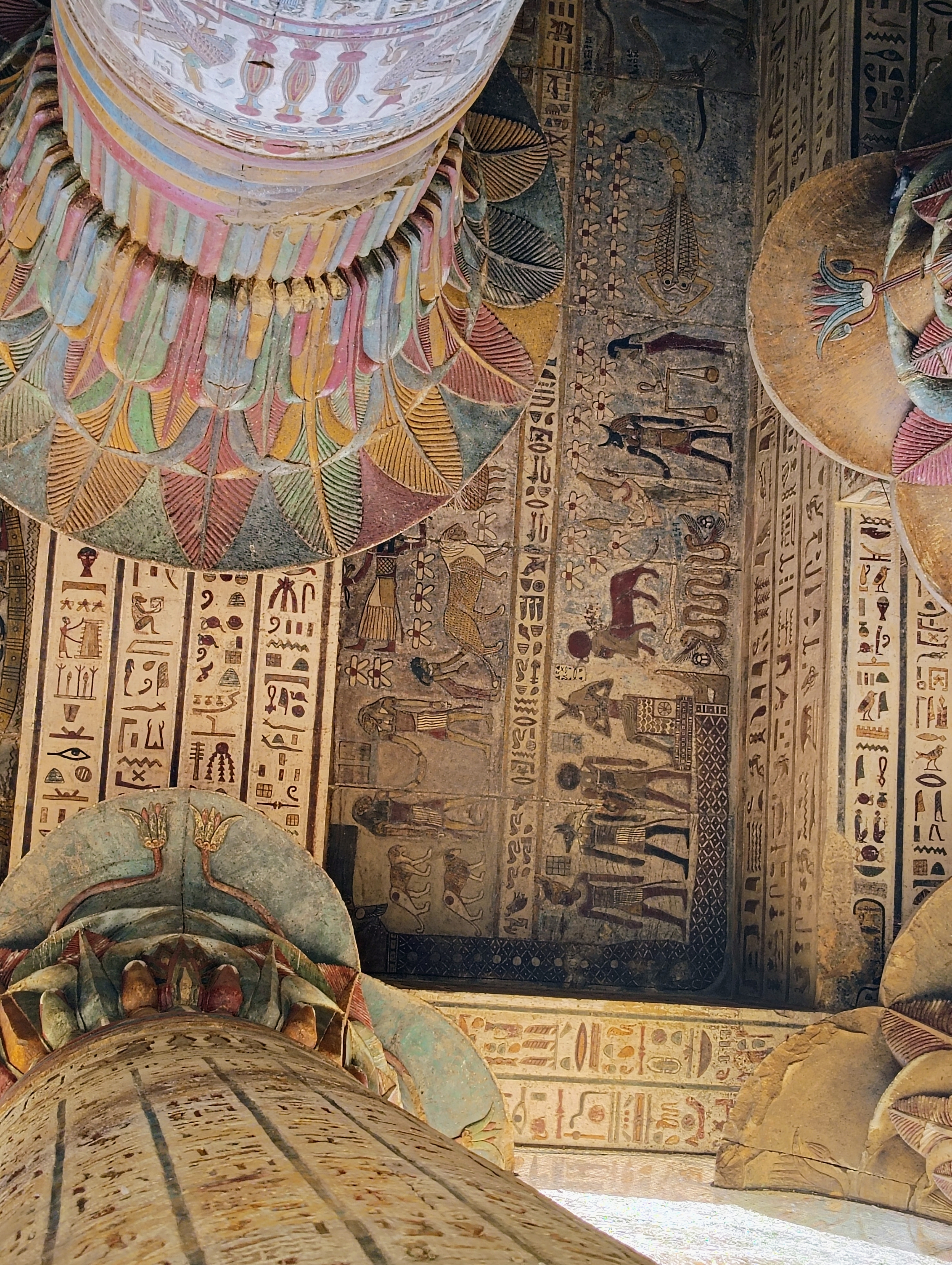
Below is a photo capture of three columns from ESNA temple in Egypt showing three examples of lotuses atop pillars, alongside an ancient depiction of the zodiac calendar which merges Egyptian story elements of the Book of Gates with modern zodiac symbology such as the scorpion (SCORPIO) as seen in the photo adjacent to the scales of LIBRA, which parallels the scales of the Hall of Two Truths, as the two stories are superimposed over top of each other by placing the beginning of the sequence at GEMINI, the twin pillars, and the entry to the temple/underworld journey of the PALINGENESIA.
Photographic Evidence and the Sacramental Lotus
The visual evidence of this architectural lineage is starkly apparent when examining the surviving monumental structures of the Egyptian New Kingdom and Ptolemaic eras. Ancient Egyptian hypostyle halls feature massive stone columns crowned with vibrant, composite capitals modeled explicitly on the seshen—the lotus and the papyrus. These capitals bloom outward in a magnificent array of green, red, and blue pigments, structurally designed to mimic the emergence of the lotus from the primordial marsh.
Above these lotus capitals, the ceilings of these halls display intricate astronomical and mythological registers, featuring deities, zodiacal alignments, and animal figures mapping the constellations and the hours of the night sky. This is not mere decoration; it is a functional celestial map. The Egyptian hypostyle hall was designed to be a microcosm of the universe. The columns are the papyrus and lotus stalks rising from the waters of creation, supporting the starry vault of the cosmos.
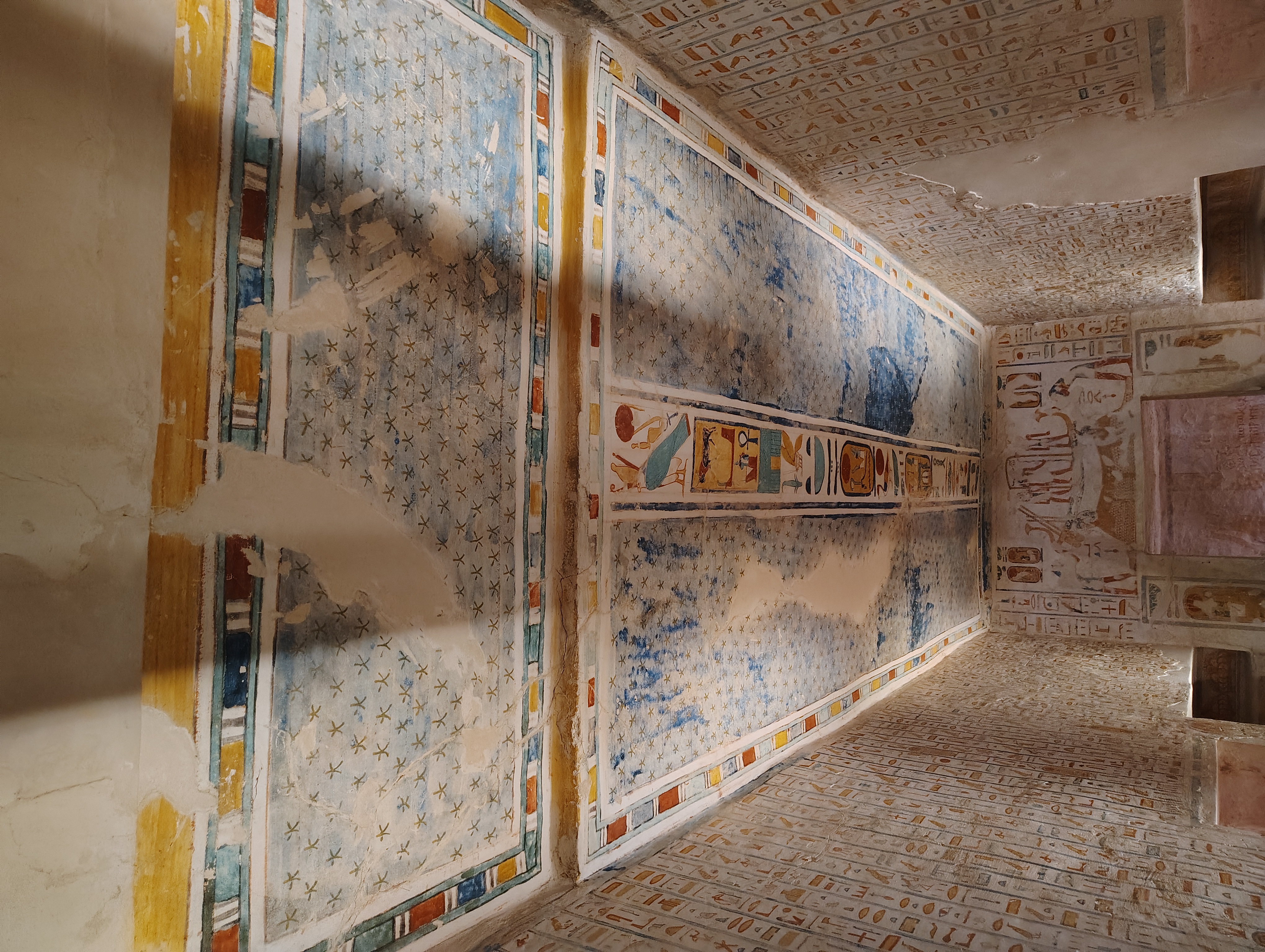
This is the exact architectural and symbolic blueprint that was transmitted to the Solomonic Temple via the Tyrian craftsmen, and which is painstakingly replicated in the layout of the modern Masonic lodge. Every traditional Masonic lodge features a "starry-decked heaven" upon its ceiling, supported by pillars that mark the celestial bounds. The Egyptian origin of the Masonic environment is architecturally unmistakable; the lodge is an Egyptian hypostyle hall abstracted and preserved through geometry and ritual.
Photo below: Star lined ceiling from KV2 tomb of Ramesses IV, Valley of the Kings, Luxor Egypt. The star lining of the ceilings may also be found inside the Holy of Holies within many, if not all, temple complexes throughout Egypt.
Beyond its architectural symbolism, the blue lotus (Nymphaea caerulea) held a practical, physiological function within the ancient mystery schools. The lotus was not merely a passive metaphor for rebirth; it was a physical sacrament used to catalyze the altered states of consciousness necessary for the initiatic descent. Modern archaeochemical analysis has confirmed that the blue lotus contains significant concentrations of psychoactive alkaloids, specifically nuciferine and apomorphine. These compounds, particularly when steeped in wine or combined with other specific botanicals (such as the Syrian rue found in Ptolemaic Bes vases), act as potent agents of neuroplasticity.
Within the highly controlled, ritualized context of the temple—guided by the priest class—the sacramental consumption of the lotus temporarily suppressed the rigid, archonic default networks of the initiate's brain. This suppression allowed the consciousness to experience the profound ego-dissolution of the "nadir" (the sixth hour) and the subsequent radiant emergence into the Akh state. The PALINGENESIA, therefore, was not merely a philosophical concept taught via lecture; it was a deeply somatic, biochemically assisted psychological death and resurrection. While Speculative Freemasonry eventually substituted the physical sacraments of antiquity with profound moral allegories and ritual psychodrama (specifically, the Hiramic legend), the underlying structural intent remains identical: to break down the hardened, uninitiated ego (the rough ashlar) and rebuild it as a masterless, illuminated consciousness (the perfect ashlar).
Conclusion: The Culmination of the Great Work
The historical trajectory of Freemasonry reveals an institution functioning as a vital temporal bridge. It connects the highly advanced cosmological science of the ancient Egyptian priesthood to the modern era, acting as a lifeboat for the esoteric knowledge of the PALINGENESIA.
Through an unbroken, though frequently suppressed, chain of intermediary conduits—the Hellenistic philosophers, the Sufi mystics of the Islamic Golden Age, the crusading Templars, and the Renaissance hermeticists—the core understanding of the human soul's capacity for radical rebirth was preserved against centuries of dogmatic orthodoxy. When this ancient lineage was formalized into Speculative Freemasonry, and subsequently exported to the American colonies by figures like Daniel Coxe and Henry Price, it provided the philosophical substrate for the Enlightenment and the architecture of a new republic founded on NATURAL LAW. The American experiment itself represents the externalization of the palingenetic ideal: the proposition that sovereignty resides within the individual, unmediated by archonic control.
The physical lodge room remains a testament to this Egyptian inheritance. The twin pillars of Jachin and Boaz stand as the eternal Gemini gateway, balancing the solar and lunar forces of the cosmos. The biblical "lily-work" that crowns them is the ultimate botanical cipher—the Egyptian seshen or blue lotus—symbolizing the triumphant twelfth-hour emergence of the soul from the dark waters of ignorance. To enter the lodge and walk between the pillars is to step into the Amduat; it is an invitation to shed the brands of the profane world and undertake the great work of the PALINGENESIA. In preserving this symbolic and ritual architecture, Freemasonry ensures that the ancient science of spiritual regeneration remains accessible, offering the initiated mind a pathway to reclaim its masterless, radiant nature.
This website is born to provide a map, and function as source of information regarding the nature of the profane/vulgar mind so characterized by the condition of PSYCHO-VULGARISM alongside its descriptors of the NEUROLOGICAL MECHANISMS and lastly provide information regarding the mostly forgotten solutions for remedy historically deployed by ancient priestly organization around the world that we know today as SACRAMENTS AND ENTHEOGENS specifically by housing the required information to understand the true nature of this problem that is the target of remedy for THE GREAT WORK altogether thereby unifying and coordinating the efforts of all people who operate individually or within any institution and holds power to make changes in this world in pursuit of the same.